‘Both my woods and my life have turned upside down.’
Sunday Independent, 04 October 2026 - by Niall MacMonagle
When Paul Ringrose died aged 61 in 2019, The Guardian obituary singled out for particular praise his west Cork woodland paintings as "visceral, immersive experiences".
Born in Dublin, Ringrose studied art history and archaeology at UCD, earned a diploma at NCAD and moved to north Tipperary where he lived as a caretaker and painter of his aunt's Georgian house before it was sold. He stayed on in Tipperary, lived in different cottages and painted the landscape around him.
In 1986, he moved to Berlin where he spent a decade working as gardener on the Royal Air Force base, and as a labourer and painter-decorator. He also worked as a set painter and lighting designer in the Schiller Theatre.
Ringrose was very interested in German politics. According to his Berlin-based artist friend Paul Mooney, Ringrose "loved the way the Germans were so politically active; the normal man on the street in Ireland would say, 'Oh, what can I do about that? Nothing. It's not in my hands.' Paul was very impressed that the German people said, 'I can do something about that."
Back in Ireland, Ringrose lived at home in Clonskeagh before moving in with friends in Portlaoise. After returning to painting, he had his first solo exhibition at Laois County Hall in 1997, aged 40. More caretaking followed, at Knockmaroon, the Guinness estate near Farmleigh. With its mature native woodland, it took Ringrose, in his brother Fergal's words, "into the woods".
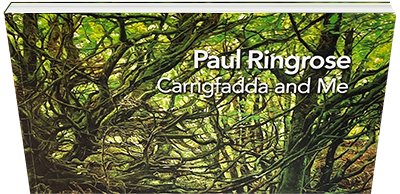
He then moved to west Cork where began his signature paintings of woodland and hedgerows — atmospheric, impressive, immersive, powerful works. He also painted sunlit fields, empty country roads and Lough Hyne; but man's negative presence is evident in paintings of rusting abandoned cars, barrels, tyres and tractors in beautiful landscapes.
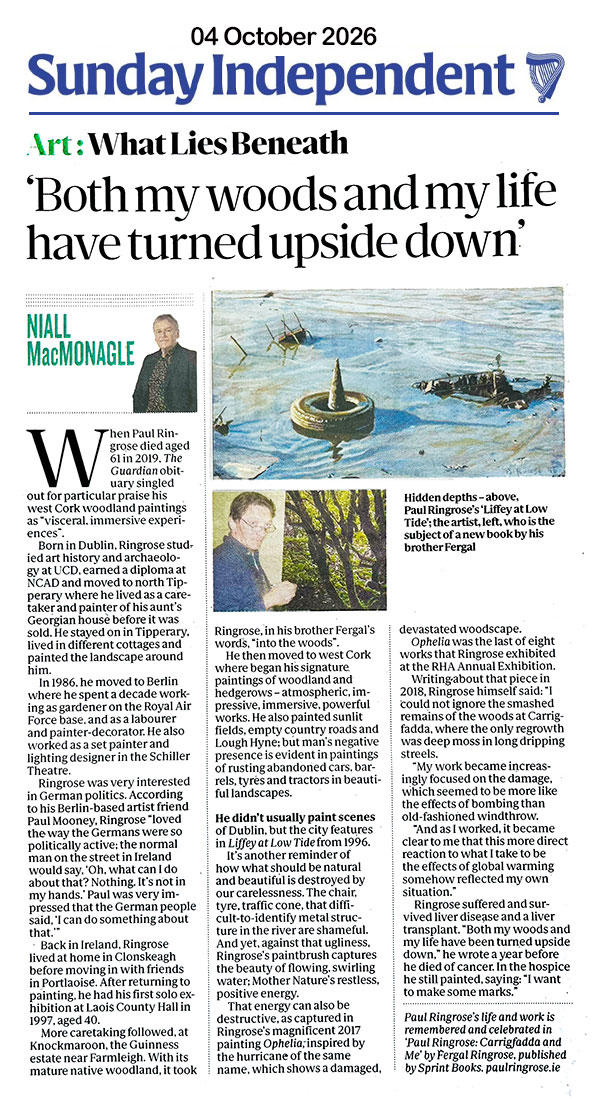
He didn't usually paint scenes of Dublin, but the city features in Liffey at Low Tide from 1996. It's another reminder of how what should be natural and beautiful is destroyed by our carelessness. The chair, tyre, traffic cone, that difficult-to-identify metal structure in the river are shameful. And yet, against that ugliness, Ringrose's paintbrush captures the beauty of flowing, swirling water; Mother Nature's restless, positive energy.
That energy can also be destructive, as captured in Ringrose's magnificent 2017 painting Ophelia, inspired by the hurricane of the same name, which shows a damaged, devastated woodscape. Ophelia was the last of eight works that Ringrose exhibited at the RHA Annual Exhibition.
Writing about that piece in 2018, Ringrose himself said: "I could not ignore the smashed remains of the woods at Carrigfadda, where the only regrowth was deep moss in long dripping streels. My work became increasingly focused on the damage, which seemed to be more like the effects of bombing than old-fashioned windthrow. And as I worked, it became clear to me that this more direct reaction to what I take to be the effects of global warming somehow reflected my own situation."
Ringrose suffered and survived liver disease and a liver transplant. "Both my woods and my life have been turned upside down," he wrote a year before he died of cancer. In the hospice he still painted, saying: "I want to make some marks."